
Generic selectors
Exact matches only
Search in title
Search in content
Post Type Selectors

Description

Product Description

Amyotrophic lateral sclerosis (ALS) is a late-onset neurodegenerative disease of the motor system, characterized by selective and progressive loss of motor neurons, eventually leading to paralysis and death within 2–5 years [1].  iPSC-derived motor neurons are valuable tools for biochemical analysis, disease modelling and clinical application of this disease.  Cytoplasmic accumulation and nuclear loss of the RNA binding protein transactive response DNA-binding protein 43 (TDP-43) from affected neurons in most instances of ALS [2-3]. Over 40 dominantly inherited mutations in the gene encoding TDP-43 have subsequently been identified in familial ALS patients [4], implicating TDP-43 dysfunction in the vast majority of ALS cases.

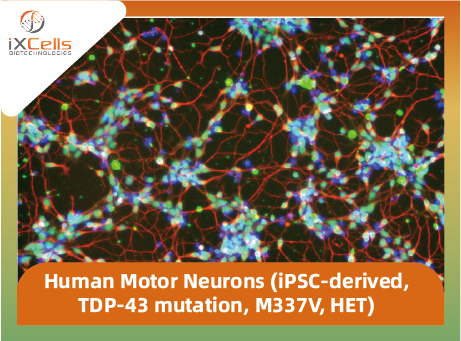
Human Motor Neurons (iPSC-derived, TDP-43 mutation, M337V) is derived from a genetically modified normal iPSC line carrying the heterozygous or homozygous M337V mutation in the TDP-43 gene (Figure 1). iXCells™ hiPSC-derived motor neurons express typical markers of motor neurons, e.g. HB9 (MNX1), ISL1, CHAT, (Figure 2), with the purity higher than 85%. iXCells™ motor neurons are available in both cryopreserved vials and fresh plate formats (12, 24, 48, and 96-well plate). Most of the cells will express high level of HB9 and ISL-1 after thawing in the Motor Neuron Culture Medium Kit (Cat# MD-0022-100ML). After culturing in the medium for 5-7 days, these cells will express high levels of CHAT and MAP2.


Figure 1. Heterozygous and homozygous M337V mutation (highlighted) has been introduced to TDP-43 gene using CRISPR/Cas9 based genome editing technology. The targeted site is verified by genomic PCR/Sanger .sequencing.

Figure 1. Heterozygous and homozygous M337V mutation (highlighted) has been introduced to TDP-43 gene using CRISPR/Cas9 based genome editing technology. The targeted site is verified by genomic PCR/Sanger sequencing.

Immunofluorescence staining showing HB9 and ChAT positive cells on day 2 and 7 in culture respectively.

Figure 2. Immunofluorescence staining showing HB9 and ChAT positive cells on day 2 and 7 in culture respectively.

Product Details

Tissue Origin Homo Sapiens, Human
Cell Type Brain Cell
Disease ALS
Package Size 1.0 million cells/vial; 2.0 million cells/vial
Passage Number P0
Growth Properties Adherent
Shipped Cryopreserved
Storage Liquid Nitrogen
Media iXCells™ Motor Neuron Culture Medium Kit (Cat# MD-0022-100ML)

References

[1] Taylor, J. P., Brown, R. H. Jr & Cleveland, D. W. Decoding ALS: from genes to mechanism. Nature 539, 197–206 (2016).

[2] Neumann, M. et al. Ubiquitinated TDP-43 in frontotemporal lobar degeneration and amyotrophic lateral sclerosis. Science 314, 130–133 (2006).

[3] Ling, S. C., Polymenidou, M. & Cleveland, D. W. Converging mechanisms in ALS and FTD: disrupted RNA and protein homeostasis. Neuron 79, 416–438 (2013).

[4] Lagier-Tourenne, C., Polymenidou, M. & Cleveland, D. W. TDP-43 and FUS/TLS: emerging roles in RNA processing and neurodegeneration. Hum. Mol. Genet. 19, R46–R64 (2010).
Datasheet & Culture Protocol

Technical Documentation

Description

Product Description

Amyotrophic lateral sclerosis (ALS) is a late-onset neurodegenerative disease of the motor system, characterized by selective and progressive loss of motor neurons, eventually leading to paralysis and death within 2–5 years [1].  iPSC-derived motor neurons are valuable tools for biochemical analysis, disease modelling and clinical application of this disease.  Cytoplasmic accumulation and nuclear loss of the RNA binding protein transactive response DNA-binding protein 43 (TDP-43) from affected neurons in most instances of ALS [2-3]. Over 40 dominantly inherited mutations in the gene encoding TDP-43 have subsequently been identified in familial ALS patients [4], implicating TDP-43 dysfunction in the vast majority of ALS cases.

Human Motor Neurons (iPSC-derived, TDP-43 mutation, M337V) is derived from a genetically modified normal iPSC line carrying the heterozygous or homozygous M337V mutation in the TDP-43 gene (Figure 1). iXCells™ hiPSC-derived motor neurons express typical markers of motor neurons, e.g. HB9 (MNX1), ISL1, CHAT, (Figure 2), with the purity higher than 85%. iXCells™ motor neurons are available in both cryopreserved vials and fresh plate formats (12, 24, 48, and 96-well plate). Most of the cells will express high level of HB9 and ISL-1 after thawing in the Motor Neuron Culture Medium Kit (Cat# MD-0022-100ML). After culturing in the medium for 5-7 days, these cells will express high levels of CHAT and MAP2.

Figure 1. Heterozygous and homozygous M337V mutation (highlighted) has been introduced to TDP-43 gene using CRISPR/Cas9 based genome editing technology. The targeted site is verified by genomic PCR/Sanger .sequencing.

Figure 1. Heterozygous and homozygous M337V mutation (highlighted) has been introduced to TDP-43 gene using CRISPR/Cas9 based genome editing technology. The targeted site is verified by genomic PCR/Sanger sequencing.

Immunofluorescence staining showing HB9 and ChAT positive cells on day 2 and 7 in culture respectively.

Figure 2. Immunofluorescence staining showing HB9 and ChAT positive cells on day 2 and 7 in culture respectively.


Product Details

Tissue Origin Homo Sapiens, Human
Cell Type Brain Cell
Disease ALS
Package Size 1.0 million cells/vial; 2.0 million cells/vial
Passage Number P0
Growth Properties Adherent
Shipped Cryopreserved
Storage Liquid Nitrogen
Media iXCells™ Motor Neuron Culture Medium Kit (Cat# MD-0022-100ML)


References

[1] Taylor, J. P., Brown, R. H. Jr & Cleveland, D. W. Decoding ALS: from genes to mechanism. Nature 539, 197–206 (2016).

[2] Neumann, M. et al. Ubiquitinated TDP-43 in frontotemporal lobar degeneration and amyotrophic lateral sclerosis. Science 314, 130–133 (2006).

[3] Ling, S. C., Polymenidou, M. & Cleveland, D. W. Converging mechanisms in ALS and FTD: disrupted RNA and protein homeostasis. Neuron 79, 416–438 (2013).

[4] Lagier-Tourenne, C., Polymenidou, M. & Cleveland, D. W. TDP-43 and FUS/TLS: emerging roles in RNA processing and neurodegeneration. Hum. Mol. Genet. 19, R46–R64 (2010).
Reviews

There are no reviews yet.

Be the first to review “Human Motor Neurons (iPSC-derived, TDP-43 mutation, M337V, HET)”

您的邮箱地址不会被公开。 必填项已用 * 标注

Related products

Add to Wishlist
Add to Wishlist
Add to Wishlist
Add to Wishlist
Add to Wishlist
Add to Wishlist
Add to Wishlist
Add to Wishlist
Add to Wishlist
Add to Wishlist